Most owners check their bank balance and call it a review. That tells you what happened, but it doesn't tell you why, or what's coming next. Those two questions are exactly where good business decisions start.
A business scorecard fills that gap. It provides a structured weekly snapshot of your performance. You can spot trends, identify problems early, and make informed decisions before small issues become expensive ones.
In this article, we'll explain what a business scorecard is and why it helps you make better decisions. You'll also learn which KPIs to review each week and the tools that keep your reporting accurate, organised, and easy to maintain.
So, let's get into it.
A business scorecard connects your weekly numbers to your strategic objectives, so every decision is backed by data. Most owners have the drive. What they don't have is a reliable system to measure it.
Have a look at what a practical business scorecard framework is like:
The balanced scorecard tracks organisational performance across four main perspectives: financial, customer, internal process, and learning and growth. The Balanced Scorecard Institute developed it as a strategy map that connects daily operations to long-term results.
And here's the thing: each perspective feeds the others. Say, a dip in employee learning often shows up later as a customer problem. And those issues eventually affect your financial results.
Most Brisbane business owners we've worked with had never used this framework before. Once they did, they stopped fixating on revenue and started fixing the actual source of the problem.

Key Performance Indicators (KPIs) measure progress by defining broad business goals through specific, trackable numbers. Strategic objectives stay vague, and growth targets stay unmet without them.
That said, not every KPI deserves a spot on your scorecard. A startup tracking brand awareness needs different strategic KPIs than an established business tracking customer lifetime value. The right KPIs depend on your current stage and priorities.
A good rule of thumb is to measure performance across no more than five to seven indicators at once. Any more than that and your attention becomes scattered. Focus on the metrics that reflect your most important business goals and remove anything that doesn't support them.
Every number has a purpose, but only a handful need your attention each week. The most valuable ones reveal what's happening with your cash flow, customer performance, and team. They're the foundation of an effective weekly scorecard.
Here are the metrics that tell you how your business is performing financially:
Weekly revenue tracking shows whether sales momentum is building or stalling before it becomes a major problem. If revenue dips two weeks in a row, that's a pattern worth acting on immediately.
At the same time, operating expenses checked regularly catch cost blowouts early, especially in businesses with variable supply or staffing costs. A single unreviewed month can absorb profits you didn't realise were disappearing.
Cash flow is the one financial metric that can sink a profitable business if ignored even for a fortnight. That’s why track your net profit margin and profit margin weekly rather than monthly. Your financial health depends on it, after all.

Customer retention rate measures how many clients keep coming back. In fact, acquiring a new customer typically costs five times more than keeping an existing one (that ratio alone should make retention a standing item).
A drop in customer satisfaction often signals a service issue long before it shows up in revenue figures. Tracking net promoter scores and customer acquisition cost together gives you a fuller picture of where the relationship stands.
On top of that, weekly retention tracking gives you a leading indicator rather than a lagging one. That way, problems are identified before they reduce customer lifetime value or weaken long-term performance.
Staff productivity and employee turnover rate are two human resources metrics worth watching every week. Both affect output and operating costs in ways many owners underestimate.
For the most part, high absenteeism is a culture signal first and an operations problem second. We've seen owners lose two good staff members in a month before realising their weekly check-ins had slipped to once a month.
Either way, owners who track employee satisfaction and engagement weekly can have more meaningful conversations with their team. That data supports continuous improvement and faster staffing decisions before small issues compound.
A scorecard is only as good as the tools feeding it. The real question is which tools deliver clear insights without adding hours to your week.
That's exactly what we're covering next:

Xero is the most widely used tool for financial reports in Australian small businesses. It pulls live data, connects directly to your bank, and keeps your numbers up to date without manual entry.
That said, financial reports alone aren't enough. Dashboard tools like Google Looker Studio or Databox let owners visualise operational KPIs in one place. With their help, you don’t need to dig through spreadsheets to monitor progress.
Eventually, the best tool is the one your team will use consistently. Complexity kills adoption, and an unused dashboard does nothing for your main business objectives or critical processes.
As businesses grow, basic accounting tools stop being enough for small and medium businesses managing multiple business units. That’s when integrated platforms become worth the investment at that stage.
Tools like HubSpot, Salesforce, or Zoho bring together sales, human resources, and financial metrics across organisational levels in one dashboard. That visibility across the entire organisation supports enhanced strategic planning and faster decision-making.
The step up in tracking capability often pays for itself within months. Most owners are surprised by how much was leaking before they had a proper system. With that visibility, you can find inefficiencies and improve productivity before they affect your bottom line.
A business scorecard gives owners a clear weekly picture across performance metrics, people, and cash. That clarity is what separates reactive owners from decisive ones.
For most businesses, you don't need a perfect system to start. Pick three to five KPIs, review them every week, and adjust as your business grows. The routine is more important than the setup.
The next step is getting the right support. Brisbane Business Coaching helps owners across Queensland build scorecards that stick. If you're ready to stop guessing, reach out to us today.
Most business owners have sat through a meeting that felt like a dead end. Everyone walks out an hour later with nothing decided or changed. If you've ever wondered why some groups get more done and communicate better, look at how they run their sessions.
High-performing teams focus on achievable goals and name the blockers that hold the group back. The teams that prepare well leave with clear next steps. We work closely with teams and leaders, so we know what drives productive sessions.
This article explores the communication habits, meeting structures, and decision-making frameworks that high-performing teams rely on. Read on, and you'll walk away with a clear starting point for your next session.
Usually, high-performing teams focus on three things: the decisions that need to be made, what is blocking progress, and the goals they are working toward. In practice, that approach alone changes the value of a session. It shifts the conversation toward resolving issues.

So what does that look like in practice? A team of five spends 20 minutes debating a decision that one person could have made before the meeting started (and yes, most groups skip straight to updates and wonder why nothing moves).
Three things consistently come up in every high-performing team's sessions.
These three areas work together. Every session ends clearer when your team knows the decisions, the progress, and the blockers.
Your meeting structure decides if your team leaves with clarity or confusion, and poor structure weakens leadership communication over time. For deeper guidance, explore these business success strategies.
Two habits alone can change the feel of every session you run.
Most teams walk into a meeting with no idea what they are there to resolve. One fix is simple: send a written agenda the day before so the group arrives prepared. A ten-minute prep will do more for your discussion than forty minutes of circling without direction. After all, the discussion stays focused from the first minute.
Once that's established, the close deserves just as much attention as the start.
High-performing teams start meetings well, but things often fall apart at the end. A clear close makes sure everyone knows what to do next. To get there, each agenda item needs a named owner and a due date, or the organisation circles the same unresolved issues week after week.
There's no way around it: a meeting without a clear close is just a conversation with a calendar invite.
Strong business teams stay aligned through consistent rhythms, outcome-focused updates, and open communication. Even talented employees pull in different directions. In fact, good leadership habits keep your people on the same page between sessions.
Let's look at the habits that keep small business teams aligned:
None of these habits requires a significant process change. Each one is a small adjustment that, over time, builds a group that communicates harmoniously.
Small business owners make better decisions when they clarify who owns which decisions before the meeting starts. Teams often bring every decision to the group. As a result, confidence in the leader starts to drop.
A clear ownership plan removes that bottleneck and keeps the whole organisation moving. Take a look at the simple breakdown of who should own each type of decision.
| Decision Type | Who Owns It | When to Raise It |
| Day-to-day operations | Team lead | Weekly check-in |
| Budget or resources | Business owner | Monthly review |
| Strategy or direction | Whole team | Quarterly planning |
| People or HR issues | Owner + manager | As needed |
This framework reduces the risk of decisions stalling in the wrong hands. Because finance calls, sales strategies, and people challenges each need a different person in the room to handle them.
To sum up, a group with clear ownership moves with confidence and less back-and-forth, while one without it keeps asking the same question in every session.
Yes. A business coach helps you see the communication and structural gaps. Most small business owners can’t get that perspective from inside their own organisation. A good business coach provides an external view and supports clearer decisions and accountability in strategy discussions.

However, coaching works best when business leaders actively participate. The teams that get the most out of each session share updates clearly, raise problems early, and leave with defined actions. A good business coach provides the expertise and guidance to help your organisation build those habits over time.
The right small business coach understands the full weight of running a small business. Cash flow pressure, staff challenges, and the demands of leadership communication all come with the territory.
That’s where Brisbane Business Coaching works with owners across South East Queensland. Our goal is to help each business build a team that speaks openly, follows through on commitments, and performs with confidence.
Well-planned meeting habits improve results and change how your team feels when they join each week. When your people leave a session with clarity, ownership, and a plan, the whole business moves in the same direction.
The commitment to clearer communication involves small, consistent changes. Your team shares updates clearly and names decisions, so results improve in both culture and day-to-day performance.
If you are a small business owner looking for that kind of support, Brisbane Business Coaching can help you. Book a session with our team and walk into your next meeting with a clear plan.
In your own business, you stop being the bottleneck by handing off tasks and building a system your team can run without you. Most owners never plan to become the hold-up. It happens slowly, one decision at a time, until every choice runs through you first.
That pattern shows up everywhere. Projects stall, and the team ends up waiting on you. And the business only grows as far as your own hours allow.
In this article, we'll cover what causes this pattern and how business delegation helps break it. Also, we’ll see what leadership development looks like once you start letting go. Keep reading to see where the bottleneck starts.
Being the bottleneck means every choice has to pass through you first. The signs usually appear gradually. You might just think you're being thorough, but the business is leaning on you for everything.
Once you spot that pattern, the next two questions are worth asking: how does it slow growth, and what's it actually costing you?
Owner approval at every step slows down decisions and delays delivery. Your team can't move forward until you sign off (even on small calls). That gap costs you real time across a busy week.
So the team starts waiting instead of acting. They ask before they decide, even when they already know the answer. That habit slows delivery across the board.
Eventually, growth stays capped at whatever one person can physically manage alone. You can only carry so much before something slips. And the business can't outgrow your own capacity.

Missing business systems mean knowledge lives in your head only. If you're the only one who knows how something works, you've probably felt that pressure to always be available (even on your day off).
Along with that, repeated firefighting eats time that should go toward strategy work. You end up solving the same problem twice, sometimes three times, because there's no process written down anywhere.
As a result, inconsistent execution creates errors that customers and employees both notice. One team member does a task one way, another does it differently, and the results don't match up. That kind of delay gradually chips away at customer satisfaction and drags down financial performance.
Business delegation fixes the bottleneck by handing over both the task and the authority to decide. Passing off the work is only the first step (that's the part most owners get wrong first). The person taking it on needs the power to make the call, too.
With that in mind, here's where most owners get stuck, and how to build systems that hold up once you step back.
Owners often delegate tasks but keep the decision-making authority for themselves. In fact, 75% of employer entrepreneurs have limited or low hand-off skills, which makes it harder to build teams that can make choices independently.
In many cases, fear of mistakes leads to micromanaging instead of real delegation. You check in too often, and the team member never gets the chance to build confidence in the role.
Long story short, no clear handover process means the handover breaks down within weeks. Having a plan for what gets passed on and when keeps tasks off your desk. True hand-off only works with shared ownership and clear expectations.
Documented processes let your team act rather than waiting on your sign-off. Once a process is written down, anyone can follow it the same way, every time. The right tools and communication streamline operations far faster than adding more meetings.
Systems document the way work gets done. We've seen the same result across our client businesses. Once the process is written down, the business no longer relies on one person's memory.
Just as importantly, early buy-in makes the system stick once it's in use. If people help outline the process, they're far more likely to follow it (rather than going back to their old way).

You can spot a business bottleneck when work keeps waiting for your approval. If every decision ends up back on your desk, the business has likely outgrown one person's capacity.
The following signs can help you identify it:
Every now and then, just one of these signs is enough to treat as a signal to act. Small delays have a habit of becoming larger problems when they keep repeating.
Leadership development looks like stepping back from daily judgment so the business can run without you in the room. It's less about learning new tricks and more about unlearning old habits. The goal is building leaders who can think for themselves.
Let's look at what it takes to make that change stick.
Business leaders practise stepping back from decisions they used to own. If you've ever hovered over someone's shoulder just to "check in," you already know how hard that first step feels.
That said, feeling uncomfortable at first is completely normal. Confidence usually grows as your team handles more responsibility instead of relying on your input every time. On-the-job training helps emerging leaders build new skills faster than any course could.
To put it another way, trust builds one at a time. So start with something low-risk, then raise the stakes once confidence grows on both sides.

Strategy work finally gets real attention instead of getting pushed aside. Once daily decisions stop landing on your desk, you have more time to focus on planning, growth, and long-term priorities.
At the same time, team confidence grows when leaders stop stepping back in. People make better choices when they're trusted to handle challenges without expecting every choice to be reviewed or reversed.
More importantly, business leaders measure success by team output rather than personal hours. They pay more attention to what the team accomplishes than to their own workload. In fact, people in leadership positions who invest in this shift tend to hit organisational goals faster.
The bottleneck disappears through three practical changes: real delegation, systems your team can follow, and a leadership mindset that lets go. Each step frees up a little more of your time and headspace.
If you're unsure where to start, pick one task this week that only you can do right now. Hand it off with a clear plan, and let your team run with it.
So, are you ready to stop being the hold-up in your own business? Brisbane Business Coaching helps business owners across Brisbane build the systems and leadership habits a growing company needs. Get in touch to start the shift.
One of your best performers hands you a resignation letter, and you never saw it coming. That's typical for strong employees. They rarely complain or slow down before they leave, which makes it easy to miss what's really happening.
And since the warning signs are often subtle, many managers assume it comes down to money or ambition. They focus on counteroffers and exit interviews, but people rarely wake up one day and decide to leave. The decision usually builds over months of feeling overlooked, undervalued, or managed in a way that slowly wears them down.
This article breaks down five specific leadership habits that drive good employees away, and how to tell if your own management style is the cause. You'll also get a clear starting point for turning things around before you lose the next one.
But first, let's look at why top performers leave without giving you any warning at all.
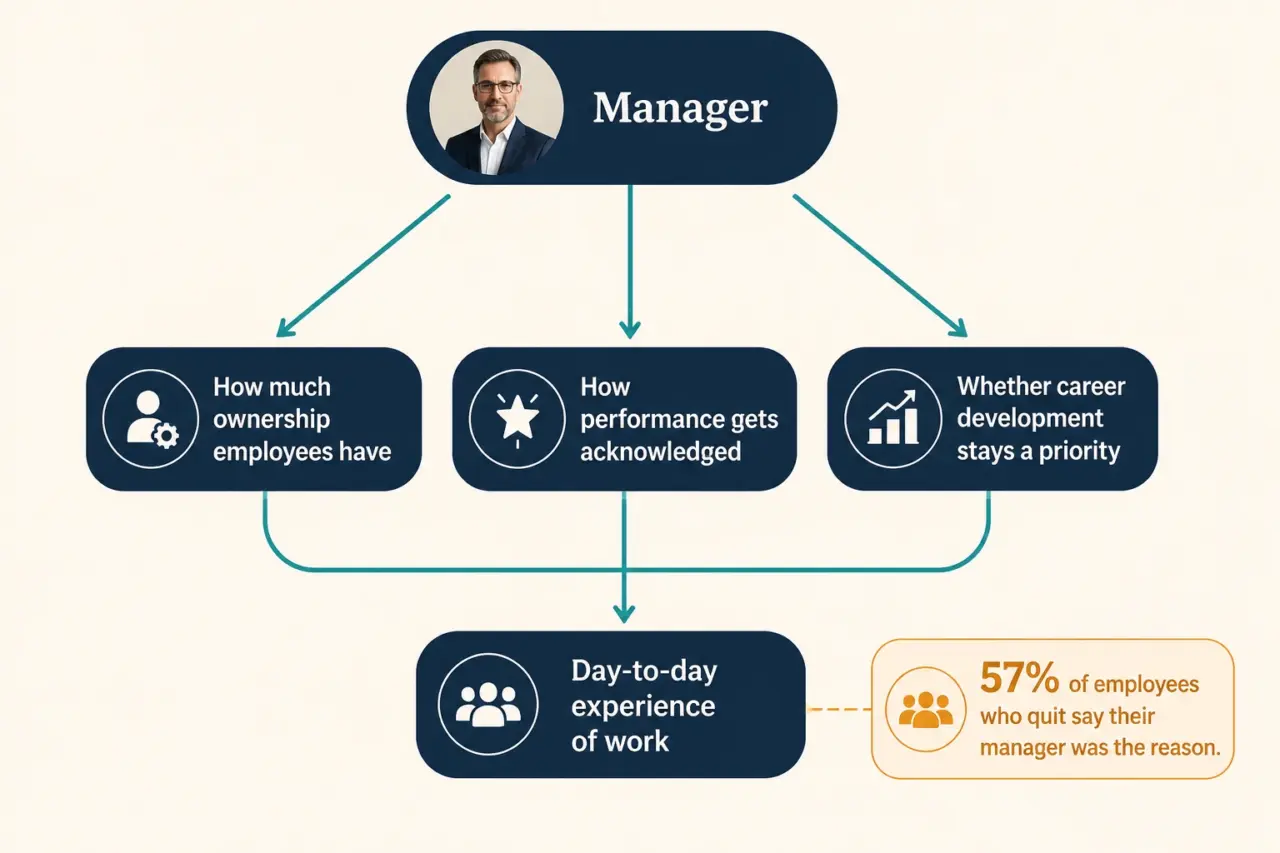
Surprisingly, the main reason top performers leave is their manager. In fact, 57% of employees who have quit a job say their manager was the reason. We often hear from workers who felt their efforts went unrecognised or that promised growth never materialised. Eventually, leaving felt like the only option.
That happens because managers have more influence over the day-to-day experience of work than any other role in a business. They decide how much ownership employees have, how performance gets acknowledged, and whether career development remains a priority. When those areas are neglected, even high performers become more receptive to opportunities elsewhere in the job market.
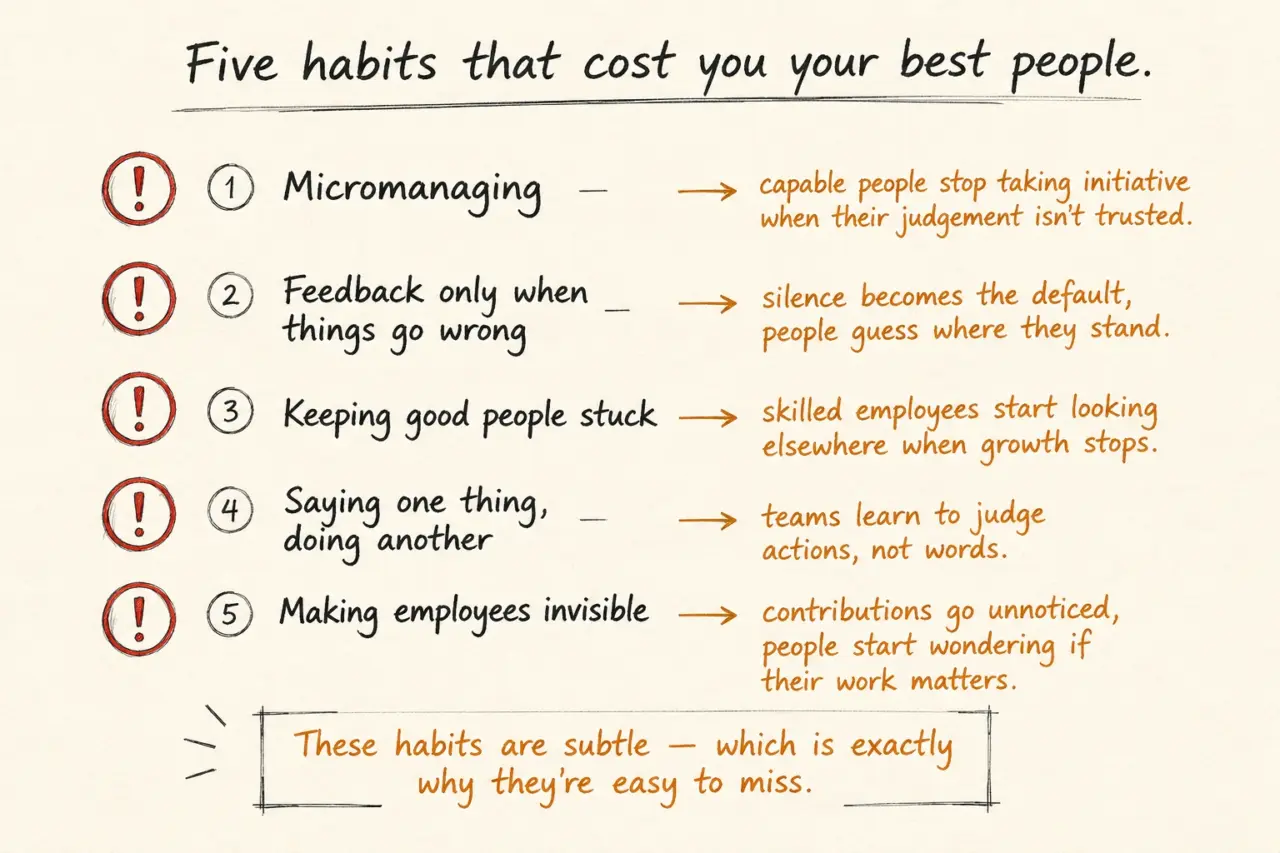
Fixing retention doesn't mean watching your team more closely or tightening your grip on how work gets done. Often, the habits that push good staff out are far more subtle than that, which is exactly why they're easy to miss. The five behaviours below are some of the most common leadership patterns that end up costing businesses their best people.
Picture a senior employee hired specifically for their judgement. But as they start working, every one of their decisions gets reviewed. And within a few months, they stop taking initiative altogether because waiting for sign-off has become easier than acting.
That's what micromanagement does. It tells capable personnel that their judgement isn't trusted (intentional or not). Over time, they stop bringing ideas forward, avoid making decisions on their own, and do only what's expected of them. Some disengage, while others leave for a workplace that actually trusts them.
If the only time a team member hears from you is when something's gone wrong, they'll start associating feedback with criticism. Eventually, silence will become the default, which will leave people guessing whether they're meeting expectations or simply being overlooked.
Something as simple as "good work on that" after a well-handled task can shift how a staff member feels about showing up. It tells your team that you're paying attention to more than just their mistakes.
Skilled employees expect new responsibilities and opportunities as they gain experience. When that doesn't happen, even people who genuinely enjoy their job can start feeling boxed in.
That feeling grows each time something disappointing happens. It could be a promotion getting pushed back, an interesting project going to someone else, or a development conversation that never seems to happen. Before long, they stop waiting and start looking for a workplace where growth is part of the job.
Your team pays close attention to whether their leaders follow through on what they say. Promising flexible hours, then questioning every time someone leaves early, is a fast way to lose credibility with the entire team.
The same goes for promises about promotions, raises, or project ownership that never materialise. When leaders fail to follow through, employees learn to judge actions rather than words.
When contributions go unnoticed, team members start to wonder if their work matters at all. This shows up in small ways, like credit for a project going to whoever presents it, or a project manager forgetting who actually solved the problem.
That said, you don't have to do anything grand. A specific, timely mention in a team meeting does more for an employee's motivation than a generic thank you sent weeks later.
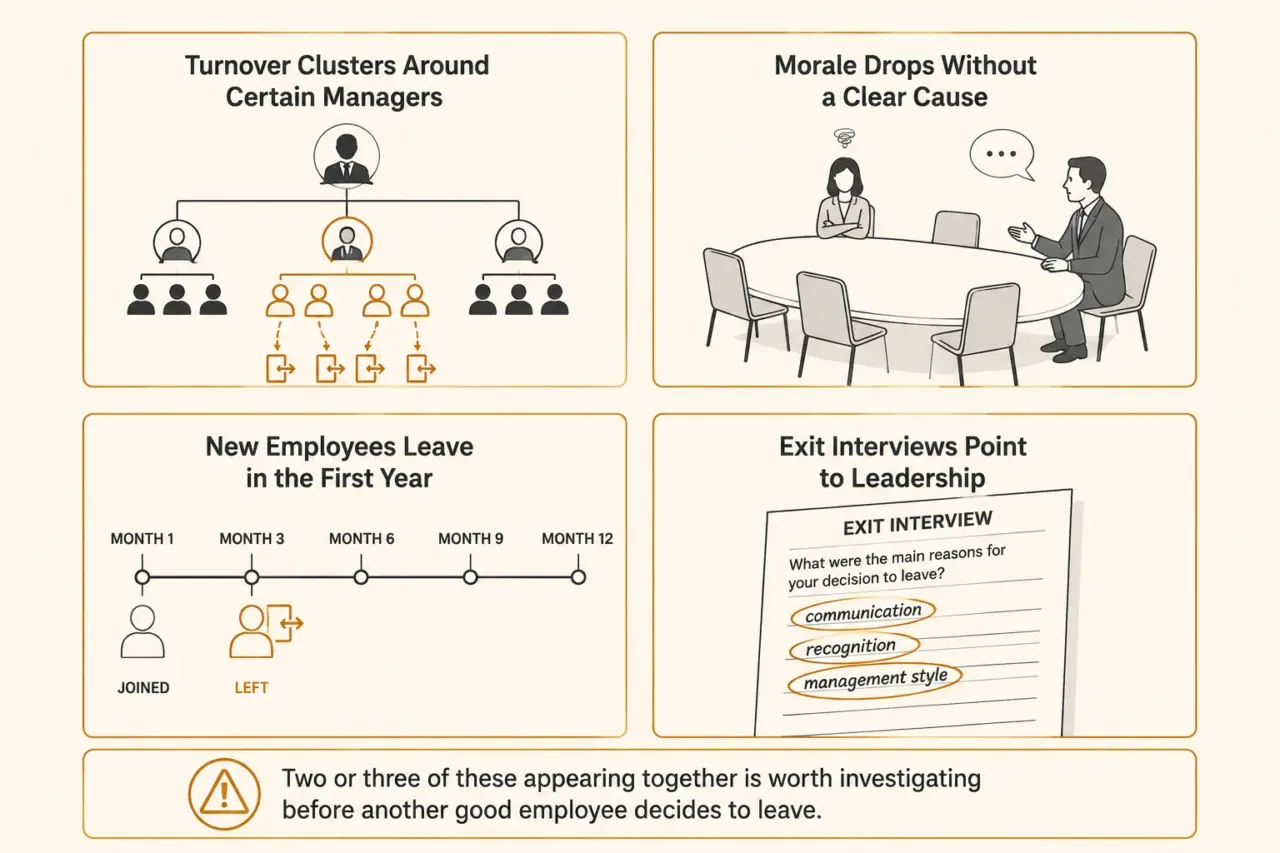
Pinpointing a specific issue within a business can be difficult, especially when you're deep in the day-to-day of running it. Fortunately, the signs of a leadership-driven retention problem are easier to spot once you know what to look for. These are some of the most common ones:
None of these signs proves anything on their own. But when two or three of them start appearing together, they're worth investigating before another good employee decides to leave. When we speak with businesses struggling with retention, it's almost always these small patterns that reveal where leadership needs to improve.

Better leaders keep their word, trust their team to do the job they were hired for, and recognise good work when they see it. They also create a positive work environment where people know what's expected of them and feel comfortable contributing ideas.
And none of that requires perfection. Your leadership just has to be consistent. These everyday habits are some of the most effective employee retention strategies because they build trust and give good people a reason to stay.
You don't need to fix all five habits this week. Pick the one that sounds the most familiar, and start there first. Building better leadership is usually the result of small, consistent improvements rather than one major change.
And if you're not sure where your own leadership style is falling short, an outside perspective helps. Brisbane Business Coaching works with leaders to spot these blind spots early, well before they turn into resignations.
Book a session with our team and get a clear, practical plan to keep your best people around for longer.
If you're still weighing up how leadership affects employee retention, these answers cover a few of the questions we hear most often.
Not always. Some turnover is healthy, particularly when it involves poor-fitting hires or natural career progression. But when good, high-performing employees keep leaving the same team, leadership is usually worth examining before assuming the hiring process is the issue.
Small teams often handle retention through day-to-day leadership rather than structured retention programs. Because one manager's behaviour affects everyone, small improvements in communication, recognition, and trust are usually noticed much more quickly.
Yes, but only if it's backed up by good leadership afterwards. A strong onboarding process helps new employees settle in faster and feel supported from day one. But if their day-to-day experience doesn't match that positive start, they're unlikely to stay for long.
Company culture is largely shaped by how managers behave day to day. When leaders build trust, communicate openly, and reward good work consistently, that becomes the culture. Employees who feel that their workplace genuinely supports them are far more productive and far less likely to leave.
Top talent tends to leave when they feel the job is consuming more than it should. Leaders who respect boundaries, distribute workloads fairly, and don't reward overwork with more overwork create an environment where employees can perform well without burning out.
Brisbane business owners hit the same wall over and over. You've got a solid product or service, but growth rarely comes easy. Revenue stays flat, staff issues keep coming up, systems that worked last year don't work now.
It almost feels like the harder you work, the less progress you actually make.
When you feel stuck in the same place, coaching can get you out of that endless abyss. And the way out is not generic advice you could find in any business book. Real coaching looks at what's happening in your company right now and builds solutions around that.
Small business owners in Brisbane have access to programs, grants, and resources most don't even know exist. The stories ahead show what happens when you tap into the right support. Let's look at how two different businesses used coaching to create genuine Brisbane business success.
Even the most capable teams can fall apart without the right structure. This Fortitude Valley consulting firm had smart, motivated people, but behind the scenes, things were coming undone.

The 12-person team at this business advisory company was stuck in constant survival mode. Every day brought another urgent task, another missed handover, another late-night fix. With no clear systems or processes, burnout spread like wildfire.
And yes, we've all seen that "too busy to plan" excuse before. This firm lived it every single day. The business leaders knew something had to change, but didn't know where to start.
After looking closely at all of their systems, the coaching found out the root cause of the firm's struggles. It turned out, the real problem was that the firm needed a structure to support the team properly. Here's what they built:
It wasn’t glamorous work, but it paid off. Research shows that companies with strong organisational systems see significantly better employee retention and performance. This consulting business proved that the pattern holds after only three months of implementation.
The change was as good as Shakespeare’s plot twists! Staff retention improved by around 90% within a year. The team went from firefighting the wildfire to forward planning. Employees stopped thinking about leaving and started contributing ideas for growth.
What’s more is that the business developed new products and services to target different market segments across Brisbane's CBD and inner suburbs. As a butterfly effect, their revenue grew by 40% as operations became smoother.
Another story is about this Paddington restaurant that had no shortage of diners. But behind the full tables and glowing reviews, the owner was exhausted. The staff kept quitting, and profits were slipping through the cracks faster than the cash came in.
The venue stayed busy most nights, but the financial situation was drying up like the Sahara. Food waste was sky-high, and menu prices didn’t match costs. There were no proper systems to train new staff, so they kept leaving.
You might be wondering how a packed restaurant could be struggling. The answer came down to margins. Menu items were priced wrong, waste was out of control, and employees kept leaving because training didn't exist (yes, exactly what happened in The Bear).
Their coaching focused on the numbers first. The owner needed to understand actual costs before making any other changes. Here's what the business implemented:
It took six months of consistent work, but the transformation stuck. Their data showed customers valued quality over cheapness.
Profit margins improved from 8% to 22% within one year. That shift changed everything. Staff turnover dropped by 60% because employees received proper training and support. The team could focus on what they loved, creating great food instead of putting out fires.
Now, with solid systems and confidence in the numbers, the owner is planning a second location.
It’s proof that in hospitality businesses, being busy isn’t the same as being profitable. Once the owner stopped running on autopilot and started managing strategically, everything changed for the better.
None of these wins happened overnight, and none of them happened by accident. So what's the real deal here? Every owner made a choice to step back, get help, and do things differently.
They stopped trying to fix everything alone. That first step back changed everything. Pride keeps so many small business owners stuck longer than they realise.
No matter what, the numbers don't lie, folks. Each company developed a clear business plan with specific milestones. Vague goals like "grow the business" got replaced with concrete targets. Data and research drove informed decisions instead of guesswork.
Here's what worked across both businesses:
Growth doesn't happen by accident. These habits might sound simple, but together they make a powerful difference. Once these business owners committed to structure, consistency, and coaching, progress started to grow like Jack’s beanstalk.
All these entrepreneurs chose to invest in coaching before the crisis hit. They saw the warning signs and acted.
Always remember: Waiting until everything falls apart costs far more money and energy than getting help early.
Running a small business can feel like you’re doing everything by yourself. But in Brisbane, you’re never alone! It is one of Australia’s most supportive ecosystems for entrepreneurs, offering real tools, funding, and community to help local businesses grow.

So you have zero excuses to sit stuck! Here are some helpful guidelines for you to start being part of the business network.
The Brisbane Economic Development Agency provides expansion support for small businesses ready to grow. Lord Mayor Adrian Schrinner champions programs that help enterprises succeed at every stage.
One standout example is the Lord Mayor’s Business Awards. For many winners, the recognition opens doors to investors, partnerships, and media opportunities that transform their trajectory.
There’s also the Brisbane City Council that operates a 24/7 Business Hotline for immediate contact and support.
The Brisbane Business Hub offers free workshops where entrepreneurs can develop skills and create strategies. You can utilise these programs to connect local business leaders with the tools and insights they need.
You’ll also find valuable data through the Brisbane Community Profile. It’ll help you understand your target customers and market trends before making big decisions.
And if you’re ready to expand beyond the local market, the Brisbane Economic Development Agency connects businesses to world markets through export programs. That can support your business with grants, trade shows, and global promotion opportunities.
Many successful business owners in Brisbane say the same thing: they didn’t grow alone. The city’s support programs, community hubs, and local mentors helped them find focus, accountability, and opportunity.
They could achieve success because Brisbane’s small business ecosystem is a collection of resources and a network built on collaboration.
If your business reaches a point where hard work doesn’t feel enough anymore, then yes, that’s usually the moment when coaching makes sense.
Check out this potentially relatable list! If any of these sound familiar, it might be time to bring in an outside perspective.

If you saw yourself in even three of the notes above, consider this guide to be your sign to get help. Business coaching can help you work smarter instead of just harder.
Keep in mind that the best time to seek coaching isn’t when things are falling apart. It’s before that happens. Too many business owners wait until the stress hits a breaking point. If you get support early, it would let you spend less money, avoid costly mistakes, and steer clear of burnout.
What It Really Takes: Remember that coaching only works when you’re ready to show up and do the work. The most successful clients aren’t just curious, they’re committed. They take the insights from each session and turn them into action.
So you’ve seen what’s possible. Real Brisbane businesses with improving revenue, culture, and operations with the right guidance. Now, it’s your turn to decide what comes next.
The truth is, no one builds lasting success alone. The business owners in these stories didn’t have all the answers. They simply reached out for help, took action, and committed to change. That’s where real growth begins.
Coaching isn’t an expense. It is an investment that pays off in confidence, clarity, and measurable progress.
So, start exploring what’s out there. Talk to a local coach. Attend a Brisbane Business Hub workshop. Connect with other entrepreneurs who’ve been where you are now.
Your next chapter could start today. One decision, one conversation, one small step at a time. Because growth doesn’t happen by luck. It happens when you decide to build with support.
Brisbane business owners hit the same wall over and over. You've got a solid product or service, but finding the right people to grow your team is rarely easy. Should you hire in-house and invest months building a loyal workforce, or outsource tasks to professionals who deliver results without the long-term commitment?
Both options work, but only if you understand the trade-offs. Hiring staff gives you control and cultural fit. On the other hand, outsourcing gives you speed and expertise over the payroll burden.
This guide breaks down recruitment versus outsourcing so you can make staffing decisions that fit your actual business needs right now. Let's dive into it.

Recruitment builds permanent employees who join your team full-time. On the flip side, outsourcing brings in external specialists for specific projects without long-term commitments or payroll obligations. That's the core difference between the two approaches.
Let's break down what each one actually looks like in practice.
The recruitment process involves advertising roles, screening candidates, conducting interviews, and onboarding new hires. You control every step from job description to employment contract, which ensures candidates fit your company culture and vision.
The process takes weeks or months, sometimes longer if you're picky about culture fit.
Staff outsourcing means hiring external professionals or agencies to handle specific tasks without adding employees to your payroll or office. These workers operate remotely, tackling projects like bookkeeping, graphic design, or customer support.
You pay for deliverables instead of salaries. Paying this way makes outsourcing flexible when workloads spike or you need skills your team lacks. Virtual assistant services let you access trained professionals with zero ongoing costs.
Remote teams let you hire talent anywhere, accessing specialists in different time zones who work while Brisbane sleeps. Video calls and project management software make managing remote workers easier than office setups.
What used to require face-to-face meetings now happens seamlessly online. And as it turns out, global talent pools offer cost savings and diverse expertise.
According to Australian Bureau of Statistics workforce data, 1.1 million Australians changed employers in recent years. The data shows high workforce mobility, which is exactly why accessing global talent can stabilise your team.

Outsourcing gives you instant access to experienced professionals without recruitment delays or training costs. What's more, you skip the long-term commitment of adding permanent staff to payroll.
Here's what makes outsourcing staff worth considering for your business.
Allowing businesses to adjust their workforce with no HR headaches is exactly why outsourcing works for growing teams.

Businesses keep recruitment in-house because it builds loyal teams who strengthen company culture and stay invested in long-term goals.
If you've ever wondered why your competitor refuses to outsource hiring, here are three solid reasons.
Developing staff internally creates knowledge that stays inside your business instead of walking out when a contractor finishes. Your team learns your systems, customer preferences, and operational quirks. At the end of the day, they become faster and more valuable with every project they complete.
Besides, internal development shows employees you invest in their future. It boosts loyalty and reduces turnover, which disrupts workflow and client relationships.
Company culture grows stronger when permanent staff share values, work together daily, and build relationships that strengthen collaboration. In other words, culture isn't something you can outsource.
And that’s mostly because contractors rarely join team meetings or planning sessions where culture gets reinforced. Hiring internally lets you screen for cultural fit during interviews. When you screen for cultural alignment first, new team members strengthen your workplace environment rather than dilute it.
Some industries need deep regulatory knowledge that takes months to develop. Finance, healthcare, and legal businesses benefit from permanent staff who understand compliance requirements and Fair Work Ombudsman hiring guidelines. These guidelines protect your company from expensive regulatory mistakes.
Meanwhile, internal specialists keep confidential information secure and build expertise over the years instead of resetting with each contractor.
Now that you understand both approaches, let's compare them directly so you can see which staffing model fits your business needs and budget.
| Factor | In-House Recruitment | Outsourcing Staff |
| Costs | Salaries, super, office space, training expenses, payroll tax | Pay for deliverables only; no benefits or office costs |
| Time to Start | 4-12 weeks from job ads to onboarding | Days or hours for urgent tasks |
| Flexibility | Fixed workforce; scaling requires redundancies | Scale up or down instantly without HR drama |
| Control | Complete oversight of operations and tasks | Less control; focus on outcomes |
| Culture | Hire for company values; employees integrate long-term | Contractors work remotely; limited integration |
| Skills | Build industry knowledge through internal training | Access global talent and specialists immediately |
| Commitment | Permanent employment with stability | Project-based; no long-term obligations |
| Security | Full control over data security and compliance | Requires secure channels and access management |
The comparison shows clear trade-offs between hiring staff and outsourcing to agencies. Outsourcing wins on speed and flexibility. You get trained professionals handling tasks within days, and you're not locked into permanent employment obligations when projects finish or workloads drop.
In-house recruitment works slightly differently. It takes longer and costs more upfront, but it builds loyalty and strengthens company culture over time. Your employees understand business operations, share vision, and stick around long enough to develop real expertise in your systems.
For most Brisbane businesses, the right answer isn't choosing one extreme. Instead, you're better off blending both approaches based on which responsibilities need permanent staff and which tasks suit contractors.

Most Brisbane business owners focus on salaries and contractor rates, but the real costs hide in benefits, turnover, training, and time spent managing teams.
First, think about your in-house staff. Employees need super, workers' comp insurance, office equipment, laptops, and ongoing training that adds 30% to their base salary annually. These expenses reduce your ability to invest in business growth.
However, outsourcing doesn't escape hidden expenses either. It mainly racks up costs through revision rounds, communication delays, and management time briefing professionals who lack context about your operations.
Besides, turnover hits the workforce particularly hard. Replacing one employee costs at least 50% of their annual salary in hiring fees and lost productivity.
So, what's the takeaway? Contractors and agencies charge premium rates upfront but eliminate leave, sick pay, and redundancy obligations down the track.
The right talent strategy saves your business money, speeds delivery, and builds a team that scales with growth.
Most Brisbane business owners struggle with this decision every time they need more hands on deck.
If you're struggling to decide, hire a business coach who can assess your needs and guide you toward the right strategy.
Outsourced workers need access to customer data and business systems. When you give external teams access to sensitive information, you're opening the door to security risks. And you need strong contracts, tight access controls, and proper compliance processes to protect your business.
So what goes wrong when businesses skip the security basics? Outsourced staff handles your customer information and proprietary systems daily. If your contracts don't include clear confidentiality clauses, you're leaving sensitive data exposed to potential breaches.
The fix is straightforward. Use non-disclosure agreements, limit system permissions to essential tools, and require two-factor authentication for every remote worker. This protection becomes absolutely necessary with offshore teams operating outside Australia.
Australian businesses must comply with Privacy Act requirements when sharing customer data with contractors in different jurisdictions.
Look, regular security audits and secure communication channels help reduce risk. But the reality is that in-house teams still give you tighter control over sensitive information and operations.
Brisbane businesses waste thousands every year on outsourcing mistakes that could've been avoided with better planning and realistic expectations. Many small businesses face workforce challenges, including skills shortages that make poor decisions even costlier. The good news is that most of these mistakes follow predictable patterns.
Watch out for these traps when you're outsourcing staff or services.
These mistakes cost you time, money, and client relationships unnecessarily.
Combining permanent staff with outsourced specialists gives you stability and flexibility when you need it most.
Brisbane businesses that get this right mix in-house core competencies with outsourced professionals. You get stability from permanent staff who understand your operations and flexibility from contractors when workloads spike. Why does this approach work better? Well, most businesses need both control and adaptability to grow sustainably.
Our suggestion is to keep customer-facing roles, strategic planning, and leadership positions in-house where company culture and long-term vision drive decisions. These roles require people who understand your business values deeply. Contractors juggling multiple clients can't provide that same commitment.
In contrast, outsource administrative tasks, seasonal demand spikes, and technical one-off projects that don't need permanent headcount. These tasks don't require deep company knowledge to execute well. Virtual assistants handle support work efficiently without office space or full-time salaries.
Worth Noting: This hybrid model protects your company culture while giving you access to global talent for specialised skills (and it saves you from hiring mistakes). Regular communication between in-house staff and outsourced workers prevents information silos and keeps brand messaging consistent.
Your staffing decisions shape your business future across Australia, so take time to evaluate both outsourcing companies and in-house recruitment against your actual specific needs instead of following industry trends.
Mix both approaches strategically rather than picking one extreme, and you'll build a team that adapts when market conditions shift. The best Brisbane businesses use hybrid staffing models that streamline operations, improve efficiency, and maintain service quality through highly skilled professionals while reducing costs.
Need help creating a staffing strategy that actually works for your business? Speak with our team at Brisbane Business Coaching to build a hiring plan that supports sustainable growth without breaking your budget.
Here are the most common questions Brisbane business owners ask when deciding between hiring a local team or outsourcing to agencies and outsourcing companies.
Leadership responsibilities, HR work involving employee disputes, and core operations handling confidential financial data should stay with in-house staff. These positions protect company culture and require deep expertise in your business operations and infrastructure.
You schedule regular check-ins through video calls, include remote professionals in team celebrations, and set clear expectations by documenting your company values. When outsourced staff work across different time zones, consistent communication becomes essential for maintaining service quality and operational efficiency.
Local Brisbane staffing agencies and outsourcing companies cost more than offshore services across Australia. However, they eliminate time zone issues and workforce challenges like language barriers while reducing costs in other areas. Highly skilled professionals understand Australian business practices and client expectations, which often justifies the higher expenses for growing businesses seeking to streamline operations.
A recruitment business coach analyses your specific needs, evaluates whether to hire employees or use outsourcing services for tasks like software development and engineering support, and helps avoid expensive mistakes. Business coaches bring industry expertise and resources that help you improve efficiency and make smarter talent acquisition decisions, allowing companies to scale effectively.
Updated: 19 April 2026
You can find a business mentor through your existing network, at industry networking events, via government programs like TAFE Queensland, or on LinkedIn. Just remember that the best mentors usually come from genuine connections you build over time.
But finding the right business mentors takes effort, though the support they provide helps small business owners grow quickly while avoiding costly mistakes that set them back months.
This guide from Brisbane Business Coaching walks you through where to look, what to ask for, and how to approach potential mentors without making things awkward. By the end, you'll know exactly where to start your search.

A business mentor is an experienced professional who shares real-world guidance based on what they've actually built. They help you avoid costly mistakes and grow your business faster than you would by figuring everything out alone.
Unlike consultants you hire for particular projects, business mentors build long-term relationships focused on your overall development and success. They're not there to run your business or tell you exactly what to do. Instead, they ask hard questions that make you think differently about the challenges you're facing.
The best mentors bring expertise from years of making their own mistakes. They provide a perspective you can't get from your team or from reading advice online. And the mentoring relationship works because they've walked the path you're on right now.
While a business mentor builds a long-term relationship focused on your overall growth, a business coach tackles specific short-term business goals. The distinction counts because picking the wrong one wastes your time and money (who wants that?).
The table below breaks down the main differences:
| Business Mentor | Business Coach |
| Develops naturally through genuine relationships | Paid professional you hire for specific outcomes |
| Rarely charges fees for guidance | Structured fees with clear pricing |
| Informal conversations based on your needs | Fixed sessions with defined strategies |
| Long-term partnership spanning years | Short-term engagement (weeks to months) |
Business coaches offer mentoring services with clear deliverables. You pay them to improve your leadership, boost revenue, or fix a particular problem. Meanwhile, mentors guide you through the messy parts that business coaches don't cover.
Bottom Line: Choose a business coach when you need to hit an individual target quickly. But if you want someone in your corner for the long haul who understands your journey, you should go for a mentor.

The right mentor can cut years off your learning curve and help you avoid mistakes that cost other entrepreneurs thousands. You'll get three major benefits from this relationship:
Your mentor has already faced the challenges you're dealing with and knows which shortcuts work. They flag issues early, before those problems drain your cash or damage customer relationships.
After years of working with Brisbane business owners, we've seen how much quicker they grow with the right mentor. Learning from someone else's trial and error saves you time you can't get back.
How many times have you set a goal in January only to abandon it by March when daily tasks take over? If you're like most entrepreneurs, this happens more often than you'd like to admit.
But regular catch-ups with a mentor force you to follow through on plans instead of letting them slide down the track. It's harder to make excuses when you've committed to actions with someone who believes you can achieve them.
Stressful times like cashflow crunches and staff conflicts hit every founder, but a mentor normalises the struggles because they've survived similar pressures. When you have someone who understands what you're facing, you build the confidence needed to push through instead of giving up.
That emotional support counts. But finding the right person to provide it requires knowing what to look for in the first place.
Finding the right mentor starts with understanding which qualities will actually move your business forward. The harsh reality is that not every successful business owner will make a great fit for you.
Before choosing the right one, focus on these areas:
Relevant experience means your mentor has built a business at your current stage, not just worked in your industry. Someone who grew a small business to 20 staff understands your problems better than a CEO managing 500 people. If you're running start-ups or established operations, you want someone who's been where you are.
Worth Noting: Industry knowledge helps, but stage-relevant expertise counts more when you're facing growth challenges that feel overwhelming.
Great mentors listen more than they talk, asking questions that help you solve your own problems. They take time to understand your specific situation instead of lecturing about what worked for their own business.
The best mentoring relationships work as conversations where you think through decisions together, instead of just getting handed the answers. Those listening skills separate good mentors from people who just like giving business advice.
You'll apply their guidance more confidently when your mentor's approach to business aligns with yours. Similar views on customer service, staff treatment, and ethics make their advice feel genuine and trustworthy. You don't need to agree on everything, but being on the same page about core values helps the relationship work long term.

Brisbane offers several local resources, like industry associations and government programs that particularly connect small business owners. We'll start with the ones closest to where you're already doing business:
Brisbane's industry associations connect you with founders who've built what you're trying to build. They run events where you can meet potential guides face to face and ask real questions about their journey. Plus, membership often includes mentoring programs that specifically match you with the right person (convenient, right?).
Your local Chamber of Commerce works the same way. They host regular networking events where established founders show up ready to share what they've learned. The barrier to entry is low, and the people you meet actually understand the local market.
Another excellent local option is Brisbane's dedicated program that runs monthly sessions for small business owners. Each month, BBH offers free one-on-one sessions with top Brisbane business experts. These sessions provide personalised support and practical strategies for your particular business challenges and goals.
Reminder: Book your spot early as these complimentary sessions fill up quickly each month.
If you'd rather work with someone who knows the local market inside out, our team at Brisbane Business Coaching specialises in helping entrepreneurs cut through the noise and focus on what actually drives results.
Your existing network of former colleagues, managers, and alumni connections often includes potential mentors you haven't considered.
Former managers, colleagues, and professors often make excellent guides because they already know your strengths and how you work. They've seen you handle pressure and solve problems, which means the conversation starts from a place of trust instead of you having to prove yourself all over again.
Outside of work, your personal network holds potential too. Ask friends and family if they know successful entrepreneurs willing to share advice over coffee. For example, the person running the cafe you visit might have scaled from one location to three. Or your neighbour could have sold a business last year. (Most people don't broadcast their success, so you won't know until you talk to them)
If you went to university, those alumni networks work the same way. Graduates who've built profitable businesses often mentor younger alumni because someone did the same for them. Just reach out through LinkedIn or your alumni portal, and you'll be surprised how many are happy to have a conversation.
But if your network feels tapped out, networking events open up completely different circles of people.

Networking events give you face-to-face access to veteran founders who are already open to sharing advice. These events work because everyone shows up expecting to exchange ideas and make connections.
When you find someone interesting, here's what to do:
The connections you make at these events can become long-term relationships if you put in the effort after the handshake.
You can find a business mentor through Queensland's free government-backed programs that match you with veteran advisors. These programs cost nothing and connect you with people who've actually built businesses.
TAFE's mentoring program matches you with experienced guides across finance, marketing, and operations. These aren't generic consultants. Instead, they're people who've built and run small businesses themselves.
The program includes one-on-one sessions and workshops tailored to your business development needs, covering everything from marketing strategies to financial management.
Sometimes you need help with cash flow, staff management, or business planning, but don't know where to turn. In these situations, the Small Business Solutions program matches you with someone who's dealt with those exact problems through an online application that asks about your challenges and industry.
If you want free mentoring from seasoned volunteers matched to your industry, the M4G program is your answer. It connects you with volunteer business mentors who have extensive experience in your industry.
All you need to do is register your interest online, and they'll match you based on your business goals and challenges. The program also includes free panel webinars where you can learn from multiple mentors simultaneously, which gives you different perspectives on the same problem.
These government programs give you access to quality advice without the cost. For more intensive coaching with proven frameworks, Brisbane Business Coaching provides structured support beyond free mentoring programs.
LinkedIn lets you research and connect with Brisbane business owners who've already achieved what you're working toward.
Start by being specific. Search for people in Brisbane who've achieved what you're aiming for. Once you've got a list, refine it. Use filters to narrow by location and industry, so you're not scrolling through thousands of random profiles. Look at:
That online research tells you whether their experience actually matches what you need (which beats discovering the mismatch three months in).
We've seen most people send a connection request with a generic message or immediately ask for help. Then they wonder why nobody replies.
Instead, try this. Follow potential guides for a few weeks first. After that, engage with their posts and add thoughtful comments showing you actually read what they wrote. Finally, when you do reach out, reference something specific they shared that helped you think differently.
That approach gets you actual responses instead of silence because you've shown genuine interest in learning, not just collecting contacts. Building that connection takes time, but it beats cold messaging strangers.

Now that you've identified potential mentors, here's how to approach them without making it awkward.
At the end of the day, you're asking someone busy to invest in your success. The more you can show that you'll make that investment worthwhile by taking action on their advice, the more likely they'll say yes.
Finding a business mentor takes effort, but the payoff is worth it. The right guide helps you unlock your business potential better than going it alone.
Start today with your network, check out local programs like TAFE Queensland and BBH, or connect with people on LinkedIn. Pick one approach from this article and take action this week.
Brisbane Business Coaching works with business owners across Queensland who want clarity, accountability, and real growth. If you need support building your business with proven strategies, get in touch with us.
People often ask similar questions about finding and working with business mentors. We've gathered the most common ones here.
Business mentorship costs vary widely across different sectors. For example, free options like TAFE Queensland and M4G provide invaluable support for new entrepreneurs, while paid coaches charge $150 to $500 per hour, depending on their expertise. That's why exploring free programs first helps entrepreneurs just starting out make informed decisions about whether paid coaching makes sense down the track.
Before your first session, create a clear list of your business goals and the specific challenges you want help with. Your preparation should include a business plan outline, financial records, and questions about how to expand your operations. Many mentors also provide tailored support through templates and frameworks during your sessions, but coming prepared shows you're serious about moving forward.
Absolutely. Mentorship programs across Brisbane specifically support women starting their business journey in various sectors. TAFE Queensland even offers training and education sessions that help female entrepreneurs succeed. The M4G program also connects women with mentors who understand the unique challenges they face when trying to create and grow their ventures.
Besides, Brisbane Business Coaching offers personalised coaching for women building businesses who want strategic guidance beyond what free programs provide.
Focus on asking for practical tips that apply to your specific situation rather than generic advice. Between sessions, take action on what you discussed and bring results to your next meeting. This approach helps you build innovation into your business life while showing your mentor you value their time. And honestly, mentors invest more energy when they see you applying their guidance.
No. Mentors work with people at every stage, from complete beginners to established business owners looking to expand. What counts most is being honest about where you are and what you need to learn. We've even seen many successful entrepreneurs find their mentors before they had significant experience, which helped them avoid costly mistakes early on.
Copyright 2020-2026 © Matter Solutions Pty Ltd